
A living church at the heart of Adelaide’s story
Consecrated in 1849, Christ Church North Adelaide is one of South Australia’s pioneering Anglican churches. It served as Adelaide’s pro-cathedral until 1877 and remains today a place of Christian worship, prayer, music and welcome.
Built by faith, generosity and hope
By the early 1840s, residents of North Adelaide were eager to establish a church in their district. The community had raised £1,100 before Augustus Short, the first Bishop of Adelaide, arrived from England in December 1847.
Bishop Short contributed a further £100 and secured an additional £50 from the Society for the Propagation of the Gospel. An acre of land between Jeffcott Street and Palmer Place was acquired for the church.
Bishop Short laid the foundation stone on 1 June 1848 in the presence of the Governor, Colonel Robe. The stone is now concealed by the later Marryat Vestry. Despite difficulties during construction, Christ Church was consecrated and opened on 29 December 1849, free of debt.
At the beginning of the Diocese
For its first 28 years, Christ Church served as Adelaide’s pro-cathedral while Bishop Short worked towards the building of St Peter’s Cathedral.
The Anglo-Norman church was carefully furnished. Stained-glass windows adorned the apse, and the interior included polished cedar fittings and the original pulpit. Bishop Short personally provided the chancel furnishings and continued to enrich the building.
When St Peter’s Cathedral opened in 1877, Christ Church continued its life as the Anglican parish church of North Adelaide. Its former pro-cathedral role remains an important part of both the parish’s story and the history of the Diocese of Adelaide.
The church remains a place of living worship, not simply an historic building.
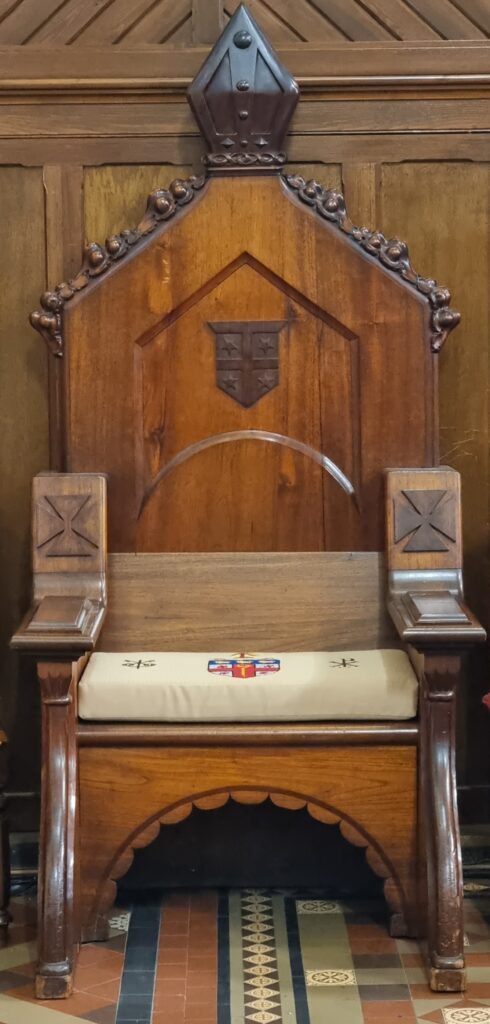
Bishop Short’s chair, used in the installation of the first nine Bishops of Adelaide
A seat of teaching and pastoral care
The Bishop’s chair, or throne, is a visible reminder of Christ Church’s former pro-cathedral status. Brought from England by Bishop Short, it served as the original Bishop of Adelaide’s cathedra, the chair symbolising a bishop’s teaching and pastoral office within the worshipping life of the Church. It was used in the installation of the first nine Bishops of Adelaide.
When the Archbishop of Adelaide occupies the chair at Christ Church today, it expresses the continuing relationship between the parish and the bishops of Adelaide and recalls Christ Church’s foundational place in the Diocese.
Historic beauty with a living purpose
Christ Church is historically significant, but it is not a museum. The worshipping life for which it was built continues every week.
Anglo-Norman character
The building is a notable South Australian example of Romanesque Revival architecture.
Local limestone
The church was built from stone quarried along the banks of the River Torrens.
Living worship
Prayer, Scripture, sacraments and the 1662 Book of Common Prayer remain at the heart of parish life.
Beauty here serves worship: drawing the eye, heart and mind towards God.
More than 175 years of parish ministry
The Rectors of Christ Church have served the parish through the founding years of the colony, two world wars, social and liturgical change, and generations of Christian witness in North Adelaide.
Their stories
William John Woodcock (1849–1868)
Born in 1808, Woodcock came to South Australia with his wife and children in 1846 under the auspices of the Society for the Propagation of the Gospel. A strong Evangelical, he became a Canon in 1849 and Archdeacon of Adelaide in 1856. He was among the founders of St Peter’s Collegiate School.
Charles Marryat (1868–1906)
Educated at Eton and Queen’s College, Oxford, Marryat was ordained priest at Canterbury in 1851. He became Archdeacon of Adelaide and, in 1886, Dean of Adelaide while continuing as incumbent of North Adelaide. His long ministry was marked by energy and ability.
George Herbert Jose (1907–1933)
Jose served with the Church Missionary Society in China before coming to Adelaide. A chaplain during the First World War, he later became Archdeacon and then Dean of Adelaide. His writings included the Annals of Christ Church and a history of the Church of England in South Australia.
Charles Herbert Murray (1933–1938)
Murray was known as a gifted preacher and religious educator. He served local schools, university students and St Barnabas’ Theological College, and helped establish the Lady Chapel. He later became Bishop of Riverina.
Arthur Leslie Bulbeck (1938–1957)
Bulbeck trained at St Barnabas’ Theological College and had earlier served a curacy at Christ Church. During the Second World War he took leave to serve as a military chaplain overseas, returning to the parish in 1944. He later became a Canon and Archdeacon.
George Benjamin McWilliams (1957–1965)
Ordained in Melbourne, McWilliams served as a Royal Australian Air Force chaplain during and after the Second World War. His experience helped him relate warmly to people from many backgrounds. He died while still Rector in 1965.
Richard Mellon Southey (1966–1973)
Southey’s ministry included wartime chaplaincy in the Middle East and parish work in Victoria before he came to Christ Church. He was remembered for compassionate spiritual guidance and care in preparing parishioners for the sacraments.
Alexander Russell Cameron (1973–1990)
Cameron served in the Royal Australian Navy during the Second World War and was ordained in 1954. At Christ Church his ministry was especially noted for pastoral care of the growing hospice and hospital population within the parish.
John Paul Collas (1991–2002)
Collas became Archdeacon of Adelaide during his incumbency. His years at Christ Church included the establishment of the Memorial Garden, dedicated in 1998 during celebrations of 150 years of Christian witness in North Adelaide. He later served as Vicar General and diocesan Administrator.
Simon Bailey (2003–2007)
Educated and ordained in England, Bailey came to Christ Church as his first Australian parish. He served as Area Dean of Adelaide and brought a lifelong love of music alongside his parish ministry.
Lyndon John Sulzberger (2007–2012)
Sulzberger trained at St Barnabas College and served in Adelaide and Sydney before returning to become Rector of Christ Church. His ministry placed particular emphasis on mission, evangelism and pastoral care.
Keith Patrick Brice (2013–2020)
Brice’s ministry included parish, chaplaincy and diocesan leadership across South Australia, New South Wales and Victoria. He served Christ Church faithfully until ill health led to his resignation in 2020, and is remembered with gratitude for his pastoral care and leadership.
More than a historic building
The best way to understand Christ Church is to experience it as it was intended: as a place of living Christian worship. You are welcome to join us on Sunday, attend a choral service, or simply begin by planning a visit.